Penetration Testing 6 min read
Penetration Testing Methodology: The 5 Phases Explained
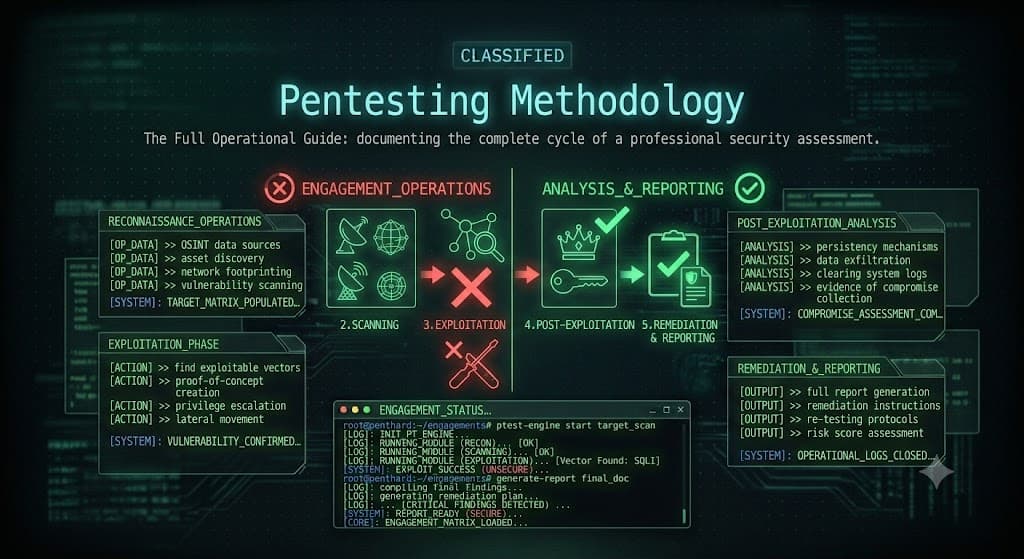
Penetration Testing Methodology: The 5 Phases Explained
A penetration test is not random hacking. It is a structured, repeatable process that follows a clear methodology from start to finish. Without a methodology, testers miss things, waste time, and produce reports nobody can trust. With one, they cover the whole attack surface, stay organized, and deliver results a company can actually act on.
This guide breaks down penetration testing methodology in simple terms. You will learn the five core phases every test follows, the industry frameworks that guide them, the different types of pentests, and the tools used at each stage. Whether you are studying for a security role or hiring a tester, this is the mental model you need.
What Is a Penetration Testing Methodology
A penetration testing methodology is a step-by-step framework that testers follow to find and safely exploit security weaknesses in a system. Think of it like a checklist a surgeon or a pilot uses. The stakes are high, so you do not improvise. You follow a proven sequence that makes sure nothing important gets skipped.
A good methodology gives you three things: consistency (every test follows the same reliable process), coverage (you test the whole system, not just the easy parts), and clarity (the client gets a clear, professional report they can understand and fix).
The 5 Phases of Penetration Testing
Almost every penetration test, no matter the framework, follows these five phases in order. Learn these and you understand the core of the entire field.
| Phase | Goal | Simple Description |
|---|---|---|
| 1. Reconnaissance | Gather information | Learn everything about the target before touching it |
| 2. Scanning | Find the doors | Discover live systems, open ports, and services |
| 3. Exploitation | Get in | Use weaknesses to gain access |
| 4. Post-Exploitation | Go deeper | See how far the access can be pushed |
| 5. Reporting | Write it up | Document everything clearly so it can be fixed |
Let us walk through each one.
Phase 1: Reconnaissance (Information Gathering)
This is the homework phase. Before attacking anything, testers collect as much information about the target as possible. The more you know, the easier everything else becomes.
There are two styles. Passive reconnaissance gathers information without touching the target directly, using public sources like Google, social media, company websites, and public records. This is often called OSINT, or open-source intelligence. Active reconnaissance interacts with the target lightly, such as looking up its domain records.
Common recon tools include whois, nslookup, theHarvester, and Maltego. The goal is to build a map of the target: its domains, IP addresses, employee names, technologies, and anything else useful.
Phase 2: Scanning and Enumeration
Now the tester actively probes the target to find live systems and open entry points. This phase answers the question, "what is running here, and what can I talk to?"
Scanning finds open ports and the services behind them. Enumeration digs deeper into those services to pull out details like software versions, usernames, and share names. The star tool here is Nmap, which maps out ports and services quickly.
bash
# A common Nmap scan to find open ports and service versions
nmap -sV -sC 192.168.1.10
Vulnerability scanners like Nessus or OpenVAS often run in this phase too, automatically flagging known weaknesses in the discovered services.
Phase 3: Exploitation (Gaining Access)
This is the phase everyone imagines when they think of hacking. The tester takes the weaknesses found in scanning and actually uses them to break in. This could mean exploiting an unpatched service, cracking a weak password, or abusing a web vulnerability like SQL injection.
The Metasploit Framework is the most famous tool for this phase, packaging thousands of ready-made exploits. But real exploitation is careful, not reckless. A professional tester avoids anything that could crash a production system and always stays within the agreed rules.
Phase 4: Post-Exploitation
Getting in is not the end. The real question a client cares about is, "how bad could this get?" In post-exploitation, the tester explores what an attacker could do after breaking in.
This includes privilege escalation (turning a low-level account into an admin), lateral movement (jumping from one machine to others on the network), and finding sensitive data. Testers also check whether they could maintain access over time. Everything is documented to show the true business impact of the initial weakness.
Phase 5: Reporting
The report is the actual product of a penetration test. A brilliant test with a poor report is nearly worthless, because the client cannot act on it. A strong report includes:
- An executive summary for managers, in plain non-technical language
- A technical breakdown of every vulnerability found
- Risk ratings showing which issues are most dangerous
- Clear remediation steps telling the team exactly how to fix each problem
- Evidence like screenshots and steps to reproduce Good reporting is what separates a professional pentester from someone who just knows tools.
Popular Penetration Testing Frameworks
The five phases above are the foundation, but the industry has formal frameworks that add detail and structure. You will hear these names often.
| Framework | Focus | Best Known For |
|---|---|---|
| PTES | General pentest process | The Penetration Testing Execution Standard, a full end-to-end guide |
| OWASP WSTG | Web applications | The go-to testing guide for web app security |
| OSSTMM | Measurable security testing | A scientific, metrics-based approach |
| NIST SP 800-115 | Government and enterprise | A respected official U.S. standard |
| MITRE ATT&CK | Attacker behavior | A huge knowledge base of real-world attack techniques |
For web application testing specifically, the OWASP Web Security Testing Guide is the most widely used checklist in the world. For a complete general process, PTES is the classic reference.
Types of Penetration Testing
Not all pentests are the same. They are described by how much the tester knows and what they are targeting.
By knowledge level:
-
Black box: The tester knows almost nothing, like a real outside attacker
-
White box: The tester has full information, including source code and credentials
-
Gray box: Somewhere in between, with partial information By target:
-
Network penetration testing: Servers, firewalls, and internal networks
-
Web application testing: Websites and web apps
-
Wireless testing: Wi-Fi networks and devices
-
Social engineering: Testing people through phishing and manipulation
-
Physical testing: Attempting to physically enter a building or facility Choosing the right type depends on what the organization wants to protect.
Final Thoughts
Penetration testing methodology turns hacking from chaos into a craft. The five phases, recon, scanning, exploitation, post-exploitation, and reporting, give every test a reliable backbone. The frameworks like PTES and OWASP add depth, and the different test types let you focus on what matters most.
If you are starting out, do not just learn tools. Learn this process first, then fit the tools into each phase. That is what real security professionals do, and it is what makes their work trustworthy and repeatable.
Reminder: Penetration testing must always be done with written authorization. Testing systems without permission is illegal.
Share
Comments (0)
No comments yet. Be the first to share your thoughts.